
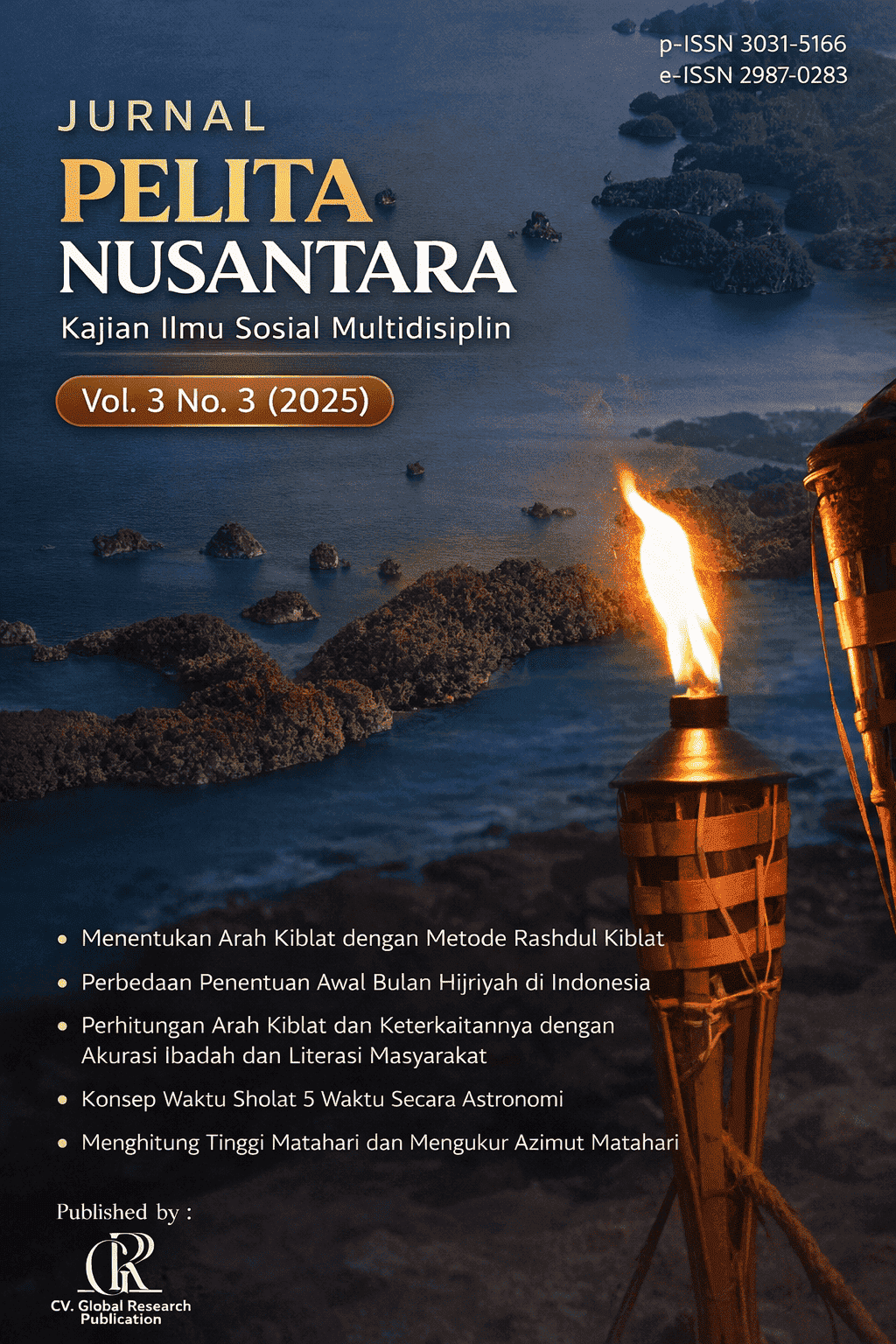
Perbedaan Penentuan Awal Bulan Hijriyah di Indonesia
Tinjauan Integratif Ilmu Falak dan Fiqh Siyasah
DOI:
https://doi.org/10.59996/jurnalpelitanusantara.v3i3.953Keywords:
Ilmu Falak, Fiqh Siyasah, Ta'abbudi Epistemology, Neo-MABIMS, Wujudul Hilal, Global Hijri CalendarAbstract
This article seeks to comprehensively examine the epistemological and astronomical roots triggering these differences, as well as to analyze their implications from the perspective of Fiqh Siyasah (Islamic Political Jurisprudence). Through a qualitative approach utilizing a library research design, this study compares various dominant paradigms, ranging from hisab hakiki wujudul hilal, imkanur rukyat (Neo-MABIMS), to the Single Global Hijri Calendar (KHGT). The results indicate that the epistemological root of the differences lies in the dialectic of interpreting rukyat (moon sighting) as a mahdhah worship with a ta'abbudi (textual-ritual) dimension, juxtaposed against the view that rukyat is merely an instrumental tool with a ta'aqquli (contextual-rational) dimension. Astronomically, the divergence is triggered by the starting point of the crescent visibility criteria, particularly the fundamental debate regarding the use of topocentric versus geocentric parameters at a 6.4-degree elongation in Neo-MABIMS, as well as Muhammadiyah's adoption of the new KHGT parameters. In the specific case of the month of Dhul-Hijjah, a sharp clash occurs between the jurisdictions of local matla' (wilayatul hukmi) and global matla' (ittihadul matla'). From the perspective of Fiqh Siyasah, the government authority (ulil amri) through the instrument of the Sidang Isbat (confirmation hearing) does not impose unification in an authoritarian manner, but rather implements a collaborative governance that upholds the freedom of ijtihad. The conclusion of this study emphasizes that the unification of Islamic timekeeping demands a methodological compromise that integrates syar'i validity and scientific certainty, along with the relinquishment of sectoral egos towards the harmonization of a global calendar.
References
Aini, N., & Azkarrula, Y. A. (2024). Pandangan Tokoh Falak tentang Elongasi pada Penentuan Awal Syawal 1443 H dalam Kriteria Neo MABIMS di Indonesia. Astroislamica: Journal of Islamic Astronomy, 3(1), 01–28. https://doi.org/10.47766/astroislamica.v3i1.2762
Alamsyah, A. M., & Ni’am, M. I. (2025). Dinamika Penentuan Awal Bulan Kamariah Nahdatul Ulama: Sebelum dan sesudah adanya formulasi kriteria imkan rukyat. Astroislamica: Journal of Islamic Astronomy, 4(1), 62–78. https://doi.org/10.47766/astroislamica.v4i1.5241
Alfalaah, S. (2025). Single Global Hijri Calendar in the Muhammadiyah Perspective: Integration of Hisab, Rukyat, and Dates Unification. Al-Hisab: Journal of Islamic Astronomy, 2(3), 181–191. https://doi.org/10.33096/jah.v2i3.26668
Anggraini, A., Salma, M. F., & Jamhuri, W. (2024). The Government’s Role in Dealing with Conflict Dynamics, Differences in Determining the Beginning of the Hijriah Month in Indonesia. Heritage, 5(2), 96–102. https://doi.org/10.35719/hrtg.v5i2.128
Angkat, M. A., & Putra, R. A. (2024). Imkanur Rukyat Mabims 3-6,4 Criteria According to the Hisab Rukyat Team of Riau Islands Province’s Viewpoint. Al-Marshad: Jurnal Astronomi Islam dan Ilmu-Ilmu Berkaitan, 10(1), 15–34. https://doi.org/10.30596/jam.v10i1.17139
Anisah Budiwati, Krismono Krismono, Saiful Aziz, Muhammad Arafat, & Danny Setiawan. (2026). Indonesian Muslims’ intention to adopt the global Islamic calendar. Cogent Arts & Humanities. https://doi.org/doi.org/10.1080/23311983.2026.2625583
Basir, A., & Fitriyani, F. (2022). Hukum Islam: Dialektika Konsep Ta’abbudi dan Ta’aqquli. Jurnal Ilmiah AL-Jauhari: Jurnal Studi Islam Dan Interdisipliner, 7(1), 27–38. https://doi.org/10.30603/jiaj.v7i1.2546
Daus, F. (2017). AYAT DAN HADIS HUKUM TENTANG HISAB DAN RUKYAT. Menara Ilmu : Jurnal Penelitian dan Kajian Ilmiah, 11(76). https://doi.org/10.33559/mi.v11i76.282
Fitriyani, F., Isfihani, I., & Octasari, A. (2024). Implikasi Kriteria Imkanur Rukyat Mabims Baru Terhadap Penyatuan Awal Bulan Kamariah Di Indonesia. Jurnal Mediasas: Media Ilmu Syari’ah Dan Ahwal Al-Syakhsiyyah, 7(2), 462–482. https://doi.org/10.58824/mediasas.v7i2.197
Hartono, R. (2018). Penentuan Awal Bulan Dzulhijjah dan Puasa Arafah di Mekkah Serta Perbedaannya dengan Indonesia dalam Kajian Ilmu Falak. IJTIHAD, 34(1), 49–64. https://journals.fasya.uinib.org/index.php/ijtihad/article/view/65
Hashim, M. R., Wahab, R. A., Nawawi, M. S. A. M., Ahmad, N., & Faid, M. S. (2025). Unification of Hijri Calendar Under One Maṭla’: A Case Study of MABIMS Through the Lens of Islamic Jurisprudence and Astronomy. Jurnal Fiqh, 22(2), 389–433. https://doi.org/10.22452/fiqh.vol22no2.7
Hastuti. (2023). Analisis pemikiran Susiknan Azhari tentang rukyat ta’abbudi dan rukyat ta’aqquli dalam proses unifikasi kalender Islam di Indonesia—Walisongo Repository [UIN Walisongo Semarang]. https://eprints.walisongo.ac.id/id/eprint/23509/
Hidayat, M. N. (2012). OTORITAS PEMERINTAH DALAM PENETAPAN AWAL BULAN QAMARIYAH PERSPEKTIF FIQH SIYÂSAH YUSUF QARDHAWI. Jurisdictie: Jurnal Hukum Dan Syariah, (0). https://doi.org/10.18860/j.v0i0.2177
Hosen, H. (2017). KILAS BALIK KALENDER HIJRIYAH INDONESIA PERJALANAN MENUJU PENYATUAN KALENDER NASIONAL. Islamuna: Jurnal Studi Islam, 4(1), 81–111. https://doi.org/10.19105/islamuna.v4i1.1352
Ismail Koto, Lila Pelita Hati, Afwan Syahril Manurung, & Anisa Suryani Siregar. (2024). Islamic Holy Days: The Contention of Rukyatul Hillal and Hisab Hakiki Wujudul Hilal Disputes for Muslims in Indonesia. Pharos Journal of Theology, 105(2). https://doi.org/10.46222/pharosjot.105.210
Jamaludin, D. (2018). Penetapan Awal Bulan Kamariah dan Permasalahannya di Indonesia. Al-Marshad: Jurnal Astronomi Islam dan Ilmu-Ilmu Berkaitan, 4(2). https://doi.org/10.30596/jam.v4i2.2441
Karim, M. F. R., & Mahsun, M. (2024). Kriteria Baru Mabims 3-6,4: Upaya Penyatuan Kalender Hijriah di Indonesia Dalam Perspektif Maqāṣid Al-Syarī’ah. Astroislamica: Journal of Islamic Astronomy, 3(1), 51–75. https://doi.org/10.47766/astroislamica.v3i1.2735
Komisi Fatwa Majelis Ulama Indonesia. (2004). Fatwa Majelis Ulama Indonesia Nomor 2 Tahun 2004 Tentang Penetapan Awal Ramadhan, Syawal, dan Dzulhijjah (pp. 216–220). Himpunan Fatwa Majelis Ulama Indonesia.
Mahdi, I., Kosasih, A., & Rahma, A. (2020). Analysis of Fiqh Siyasah on a Local Government’s Policy About the Making of a Religious and Happy Society in Bengkulu. 249–252. https://doi.org/10.2991/assehr.k.201113.047
Marni, M., & Hilal, F. (2021). ANALISIS OTORITAS PEMERINTAH DALAM PENETAPAN AWAL BULAN QOMARIAH. HISABUNA: Jurnal Ilmu Falak, 2(3), 16–32. https://doi.org/10.24252/hisabuna.v2i3.22189
Pimpinan Pusat Muhammadiyah. (2025). Kalender Hijriah Global Tunggal (KHGT). PT Gramasurya.
Rahman, F., Pujiono, P., & Muslifah, S. (2020). Penentuan Awal Bulan Kamariah Untuk Ibadah. FENOMENA, 12(2), 107–138. https://doi.org/10.21093/fj.v12i2.2264
Rahmi, N., Rizki, M., Fajriati, N. A., Nurlaila, N., Efendi, F., & Siregar, L. S. B. (2025). Contestation of the Determination of ‘Idul Adha and its Implementation According to Muhammadiyah and Nahdatul ‘Ulama. Nurani: Jurnal Kajian Syari’ah Dan Masyarakat, 25(1), 262–279. https://doi.org/10.19109/nurani.v25i1.26563
Rn, B. I. (2016). PENETAPAN AWAL BULAN QAMARIYAH PERSPEKTIF FIQH. DIKTUM: Jurnal Syariah Dan Hukum, 14(1), 1–28. https://doi.org/10.35905/diktum.v14i1.220
Rumadi, R. (2012). ISLAM DAN OTORITAS KEAGAMAAN. Walisongo: Jurnal Penelitian Sosial Keagamaan, 20(1), 25–54. https://doi.org/10.21580/ws.20.1.183
SITI SOFIAH, N. 11350016. (2015). PANDANGAN TOKOH HIZBUT TAHRIR INDONESIA TENTANG UPAYA PENYATUAN KALENDER ISLAM [Skripsi, UIN Sunan Kalijaga]. https://digilib.uin-suka.ac.id/id/eprint/17178/
Tiga Tipe Otoritas Weber: Tradisional, Karismatik, dan Rasional-Legal • Institut Ilmu Politik. (2025, December 22). https://polsci.institute/comparative-politics/webers-three-types-of-authority/
Wahyuningsih, Y., & Firdiansyah, A. R. (2025). Dynamics of the Neo-MABIMS Criteria in Determining the Beginning of the Hijri Month in Indonesia (1443–1446 H). Al-Hilal: Journal of Islamic Astronomy, 7(2), 191–204. https://doi.org/10.21580/al-hilal.2025.7.2.28379
Wanandi, Z. (2022). Analisis pemikiran Syekh Muhammad Basuini Imran dalam penentuan awal bulan qamariyah: Kitab Husn al-Jawab ‘an Itsbat Al-ahillah bi al- Hisab—Walisongo Repository. https://eprints.walisongo.ac.id/id/eprint/18991/
Wanandi, Z., Suhardiman, S., & Masuwd, M. A. (2025). Reforming Lunar Calendar in Indonesia: The Academic Legacy of Muhammad Basiuni Imran. Al-Hilal: Journal of Islamic Astronomy, 7(1). https://doi.org/10.21580/al-hilal.2025.7.1.25950
Yusal, I. M., Sani, S. W., Sholihah, F., Yunus, M. A., Aminah, S., & Ardli, M. N. (2025). KALENDER HIJRIAH GLOBAL DAN PENGARUHNYA TERHADAP PENETAPAN WAKTU IBADAH: PENDEKATAN MANHAJ TARJIH MUHAMMADIYAH. Makkah: Journal Of Islamic Studies, 1(2), 22–34. https://ojssulthan.com/makkah/article/view/342
Downloads
Published
Issue
Section
License
Copyright (c) 2026 Martinus Oktavianus

This work is licensed under a Creative Commons Attribution-ShareAlike 4.0 International License.


