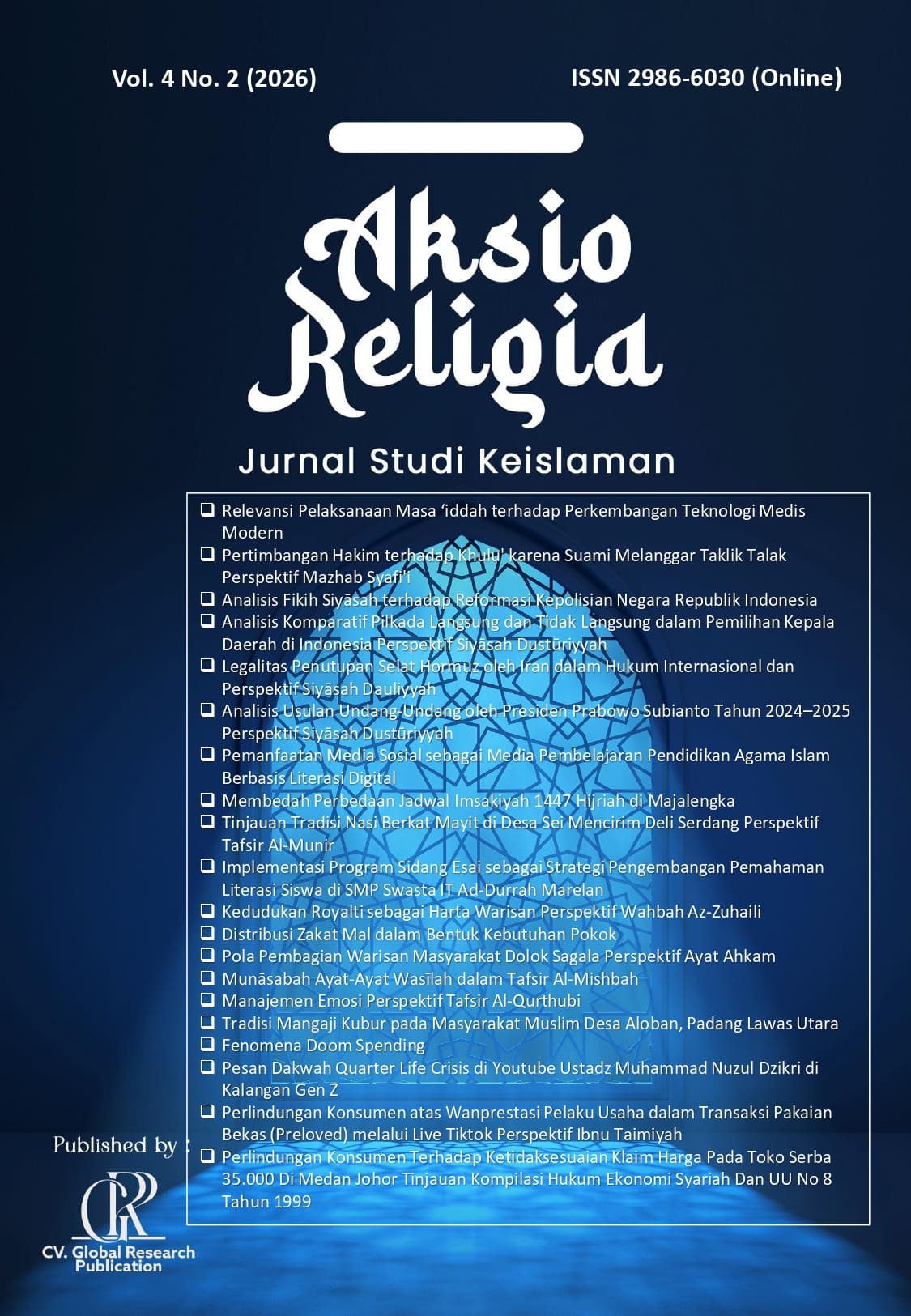
Analisis Komparatif Pilkada Langsung dan Tidak Langsung dalam Pemilihan Kepala Daerah di Indonesia Perspektif Siyāsah Dustūriyyah
DOI:
https://doi.org/10.59996/aksioreligia.v4i2.1185Keywords:
Direct Regional Head Election, Indirect Regional Head Election, Siyāsah Dustūriyyah, Al-Mawardi, DemocracyAbstract
This study aims to analyze the implementation of direct and indirect regional head elections based on Indonesian legislation and to examine both mechanisms from the perspective of siyāsah dustūriyyah. This research employed a normative legal research method using statutory, comparative, and conceptual approaches. The legal materials consisted of primary, secondary, and tertiary sources, which were analyzed qualitatively through library research. The findings indicate that the mechanism for regional head elections under Article 18 paragraph (4) of the 1945 Constitution of the Republic of Indonesia constitutes an open legal policy, allowing either direct elections or indirect elections through the Regional People's Representative Council (DPRD). However, under Law Number 10 of 2016, the prevailing mechanism remains direct regional head elections, providing direct political legitimacy from the people. From the perspective of Siyāsah Dustūriyyah, both mechanisms are acceptable as long as they uphold the principles of shūrā (consultation), al-'adl (justice), al-amānah (trustworthiness), and maṣlaḥah (public interest). Nevertheless, direct regional head elections are considered more relevant to the principle of popular sovereignty in the current Indonesian constitutional system, while indirect elections may only reflect the concept of ahl al-ḥall wa al-'aqd if conducted by representative institutions possessing integrity and prioritizing public welfare.
References
Al-Māwardī, A. al-H. A. ibn M. ibn H. (1996). Al-Aḥkām al-Sulṭāniyyah wa al-Wilāyāt al-Dīniyyah. Dār al-Kutub al-’Ilmiyyah.
Al-Qaradawi, Y. (1997). Min Fiqh al-Dawlah fi al-Islam. Dar al-Shuruq.
Cahyani, A. R. (2025). Komplektasi Perilaku Politik Pemilih dalam Pilkada Serentak 2024 pada Aspek Integrasi Tradisi Lokal dan Teknologi. Journal of Indonesian Social Studies Education (JISSE), 3(1), 12–17.
Dahl, R. A. (1989). Democracy and Its Critics. Yale University Press.
Ernis, D. (2024). DPR Usul Pilkada Provinsi Dipilih oleh DPRD. Tempo. https://www.tempo.co/politik/dpr-usul-pilkada-provinsi-dipilih-oleh-dprd-1174677
Firyalfatin. (2026). Polemik Pilkada Langsung: Antara Biaya Tinggi dan Kualitas Demokrasi. Hukumonline.Com. https://www.hukumonline.com/berita/a/polemik-pilkada-langsung--antara-biaya-tinggi-dan-kualitas-demokrasi-lt698f4fde5b9f4/
Hamdi, M. R., Adnan, I., Syarifuddin, & Hamroni. (2022). Menakar Pilkada Tidak Langsung Perspektif Politik Profetik. AL-BALAD: Jurnal Hukum Tata Negara Dan Politik Islam, 2(2), 108–128. https://doi.org/10.59259/ab.v2i2.101
Hartono, H. (2024). Urgensi Putusan MK Nomor 60/PUU-XXII/2024 terhadap Penyelenggaraan Pilkada Tahun 2024. JICN: Jurnal Intelek Dan Cendikiawan Nusantara, 1(4), 5374–5383. https://jicnusantara.com/index.php/jicn/article/view/855
HSB, A. M. (2016). Pemilihan Kepala Daerah yang Demokratis Berdasarkan Putusan Mahkamah Konstitusi Nomor 97/PUU-IX/2013. Jurnal Legislasi Indonesia, 13(3), 227–234. https://doi.org/10.54629/jli.v13i3.147
Huda, M. N. (2022). Kedudukan dan Peran Ahl Al-Hall wa Al-’Aqd serta Relevansinya pada Kinerja DPR. Staatsrecht: Jurnal Hukum Kenegaraan Dan Politik Islam, 2(1), 147–163. https://doi.org/10.14421/staatsrecht.v2i1.2527
Indonesia, K. A. R. (2019). Al-Qur’an dan Terjemahannya (Edisi Peny). Lajnah Pentashihan Mushaf Al-Qur’an.
Katsir, I. (2004). Tafsir Ibnu Katsir (Terjemahan M. Abdul Ghoffar). Pustaka Imam Asy-Syafi’i.
Khallaf, A. W. (1977). Al-Siyāsah al-Syar’iyyah. Dar al-Qalam.
Krippendorff, K. (1993). Analisis Isi: Pengantar Teori dan Metodologi (Farid Waji). RajaGrafindo Persada.
Lumbantoruan, G. S. (2024). Politik Hukum Pemilihan Kepala Daerah Langsung dan Serentak: Dinamika, Tantangan, dan Prospek Pembaharuannya. Jurnal Hukum Lex Generalis, 5(10), 1–11.
Mahkamah Konstitusi Republik Indonesia. (2024). Putusan Mahkamah Konstitusi Nomor 60/PUU-XXII/2024 tentang Pengujian Undang-Undang Nomor 10 Tahun 2016 tentang Perubahan Kedua atas Undang-Undang Nomor 1 Tahun 2015 tentang Penetapan Peraturan Pemerintah Pengganti Undang-Undang Nomor 1 Tahun 2014 tentang. Mahkamah Konstitusi Republik Indonesia.
Marzuki, P. M. (2014). Penelitian Hukum (Edisi Revi). Kencana Prenadamedia Group.
Muthalib, S. A., & Pauzi, M. F. R. bin M. (2019). Siyasah Dusturiyyah sebagai Sistem Perpolitikan dalam Al-Qur’an. TAFSE: Journal of Qur’anic Studies, 4(2), 150–166. https://doi.org/10.22373/tafse.v4i2.13176
Pardamean, M. Y. (2024). Soal Wacana Kepala Daerah Dipilih oleh DPRD, Golkar Tawarkan Konsep Ala Konvensi. Tempo. https://www.tempo.co/politik/soal-wacana-kepala-daerah-dipilih-oleh-dprd-golkar-tawarkan-konsep-ala-konvensi-1188347
Prasetyo, Y. (2024). The Stringent Support Requirements for Independent Candidates in Regional Elections: A Legal Self-Critique of Indonesian Democracy (Besarnya Syarat Dukungan Calon Independen dalam Pilkada: Auto Kritik Hukum terhadap Demokrasi Indonesia). Jurnal Konstitusi, 21(2), 226–243. https://doi.org/10.31078/jk2124
Romli, L. (2025). Pilkada Langsung, Calon Tunggal, dan Masa Depan Demokrasi Lokal. Jurnal Penelitian Politik, 15(2), 143–160. https://doi.org/10.14203/jpp.v15i2.757
Seran, G. G. (2019). Konstitusionalitas dan Desain Pemilukada Langsung Serentak Nasional. Jurnal Konstitusi, 16(3), 655–676. https://doi.org/10.31078/jk16310
Shihab, M. Q. (2002). Tafsir Al-Misbah: Pesan, Kesan, dan Keserasian Al-Qur’an (Vol. 12). Lentera Hati.
Soekanto, S., & Mamudji, S. (2007). Penelitian Hukum Normatif: Suatu Tinjauan Singkat (Edisi 1). RajaGrafindo Persada.
Sofwan, I. (2025). Dampak yang Harus Diwaspadai dalam Rangka Mengembalikan Pilkada Langsung Menjadi Pilkada Tidak Langsung dalam Perubahan Undang-Undang tentang Pilkada. Manazir: Jurnal Ilmiah Universitas Ibnu Chaldun, 1(2). https://jurnal.uic.ac.id/manazir/article/view/409
Ulya, F. N., & Akbar, N. A. (2025). Elite Golkar Tawarkan 2 Opsi: Kepala Daerah Dipilih DPRD atau Pilkada Asimetris. Kompas.Com. https://nasional.kompas.com/read/2025/07/26/11283151/elite-golkar-tawarkan-2-opsi-kepala-daerah-dipilih-dprd-atau-pilkada
Undang-Undang Dasar Negara Republik Indonesia Tahun 1945 (1945).
Undang-Undang Nomor 1 Tahun 1957 Tentang Pokok-Pokok Pemerintahan Daerah (1957).
Undang-Undang Nomor 22 Tahun 1999 Tentang Pemerintahan Daerah (1999).
Undang-Undang Nomor 32 Tahun 2004 Tentang Pemerintahan Daerah (2004).
Undang-Undang Nomor 5 Tahun 1974 Tentang Pokok-Pokok Pemerintahan Di Daerah (1974).
Wati, A. M. C., & Aryani, N. M. (2022). Relevansi Pelaksanaan Pemilihan Kepala Daerah Secara Langsung terhadap Pasal 22E Undang-Undang Dasar 1945 tentang Pemilihan Umum. Kertha Negara: Jurnal Ilmu Hukum, 10(7), 689–700. https://ojs.unud.ac.id/index.php/Kerthanegara/article/view/90211
Yaputra, H. (2024). Wacana Kepala Daerah Dipilih DPRD Kembali Mencuat, Pakar Kepemiluan Pernah Bilang Begini. Tempo. https://www.tempo.co/politik/wacana-kepala-daerah-dipilih-dprd-kembali-mencuat-pakar-kepemiluan-pernah-bilang-begini-1181029
Downloads
Published
Issue
Section
License
Copyright (c) 2026 Salwa Alya Zahra, Irwansyah

This work is licensed under a Creative Commons Attribution-ShareAlike 4.0 International License.