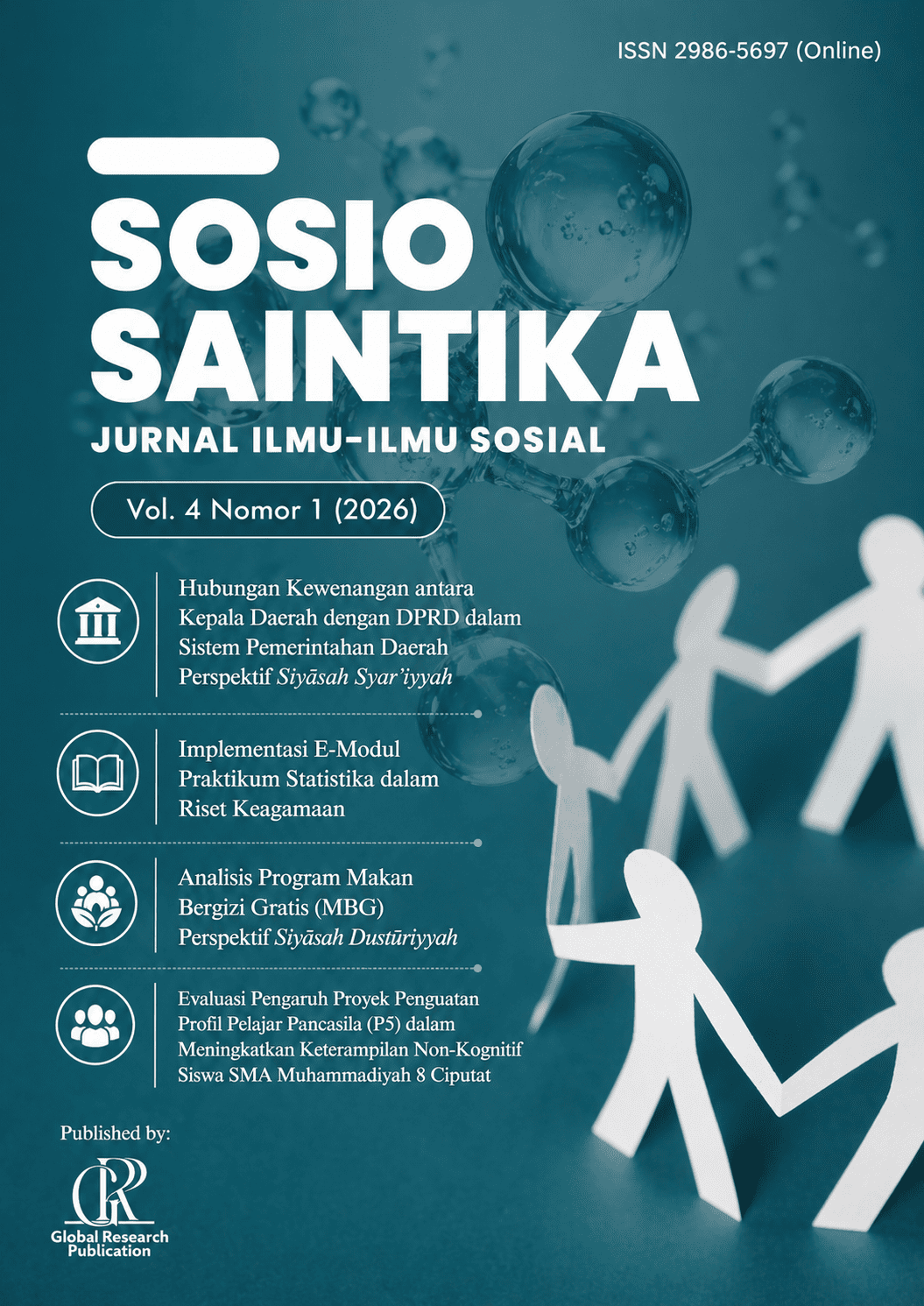
Peran Kelembagaan Gabungan Kelompok Tani (Gapoktan) dalam Meningkatkan Produktivitas Usaha Tani dan Kesejahteraan Petani Padi di Desa Perapakan
DOI:
https://doi.org/10.59996/sosiosaintika.v4i1.1223Keywords:
Farmer Group Association, Farmer Institution, Rice Productivity, Farmer WelfareAbstract
Rice farming productivity is shaped not only by land availability and cultivation technology but also by local institutional capacity to coordinate access to farm inputs, farmer learning, and collective action. This article examines the institutional role of Mitra Usaha Farmer Group Association (Gapoktan) in improving farm productivity and the welfare of rice farmers in Perapakan Village, Pemangkat District. The study employed a qualitative case-study design. Data were collected through observation, interviews with Gapoktan managers and farmer-group members, and documentation of village and institutional profiles. Data were analyzed through data reduction, data display, and conclusion drawing, supported by triangulation and member checking. The findings show that Gapoktan functions as a facilitator of production inputs, a bridge for government programs, a platform for technical learning, and a coordinator of farmer cooperation. These roles support productivity through improved planting practices, fertilization, pest control, access to quality seed, and reduced production-cost constraints. Farmer welfare improves indirectly through cost efficiency, better cultivation knowledge, strengthened social relations, and the possibility of better harvest outcomes. However, the institutional impact remains constrained by dependence on input assistance, weather risks, and limited marketing and financial functions. The findings suggest that strengthening Gapoktan should move beyond aid distribution toward a village agribusiness institution capable of supporting production, financing, marketing, and farm resilience.
References
Badan Pusat Statistik. (2025a). Luas panen, produksi, dan produktivitas padi menurut provinsi. https://www.bps.go.id/
Badan Pusat Statistik. (2025b). Produksi padi 2024: Luas panen dan hasil gabah kering giling. https://www.bps.go.id/
Demmallino, E. B., & Ibrahim, T. (2018). Efektivitas kinerja organisasi Gabungan Kelompok Tani dalam mendukung usaha tani. Jurnal Sosial Ekonomi Pertanian.
Dewi, N. L. P. R., Utama, M. S., & Yasa, I. G. W. M. (2017). Faktor-faktor yang mempengaruhi produktivitas usaha tani dan keberhasilan program Simantri di Kabupaten Klungkung. Jurnal Ekonomi dan Bisnis Universitas Udayana, 6(2).
FAO. (2024). Sustainable agribusiness and food value chains. Food and Agriculture Organization of the United Nations. https://www.fao.org/policy-support/policy-themes/sustainable-agribusiness-and-food-value-chains/en
Kementerian Pertanian Republik Indonesia. (2016). Peraturan Menteri Pertanian Nomor 67/PERMENTAN/SM.050/12/2016 tentang pembinaan kelembagaan petani. Berita Negara Republik Indonesia Tahun 2016 Nomor 2038.
Ma, W., & Abdulai, A. (2016). Does cooperative membership improve household welfare? Evidence from apple farmers in China. Food Policy, 58, 94–102. https://doi.org/10.1016/j.foodpol.2015.12.002
Markelova, H., Meinzen-Dick, R., Hellin, J., & Dohrn, S. (2009). Collective action for smallholder market access. Food Policy, 34(1), 1–7. https://doi.org/10.1016/j.foodpol.2008.10.001
Miles, M. B., Huberman, A. M., & Saldana, J. (2014). Qualitative data analysis: A methods sourcebook (3rd ed.). SAGE Publications.
North, D. C. (1990). Institutions, institutional change and economic performance. Cambridge University Press.
Sari, I. (2020). Analisis kerjasama Gabungan Kelompok Tani dalam meningkatkan kesejahteraan petani Desa Perapakan Kecamatan Pemangkat [Skripsi, Institut Agama Islam Sultan Muhammad Syafiuddin Sambas].
Sellare, J., Meemken, E. M., Kouame, C., & Qaim, M. (2023). Five stylized facts about producer organizations and rural development. Journal of the Agricultural and Applied Economics Association, 2(3), 428–444. https://doi.org/10.1002/jaa2.70
Sugiyono. (2014). Metode penelitian kuantitatif, kualitatif, dan R&D. Alfabeta.
Sujaya, D. H. (2018). Faktor-faktor yang berpengaruh terhadap produktivitas usahatani mina padi di Kota Tasikmalaya. Mimbar Agribisnis: Jurnal Pemikiran Masyarakat Ilmiah Berwawasan Agribisnis, 4.
Sunarti, E. (2009). Indikator keluarga sejahtera: Sejarah pengembangan, evaluasi, dan keberlanjutannya. Jurnal Fakultas Ekologi Manusia Institut Pertanian Bogor.
Uphoff, N. (1992). Local institutions and participation for sustainable development. International Institute for Environment and Development.
World Bank Group. (2024). Farming and Agribusiness. World Bank Group. https://www.worldbank.org/ext/en/topic/farming-and-agribusiness
Downloads
Published
Issue
Section
License
Copyright (c) 2026 Erik Darmansyah, Nia Ekaliana

This work is licensed under a Creative Commons Attribution-ShareAlike 4.0 International License.