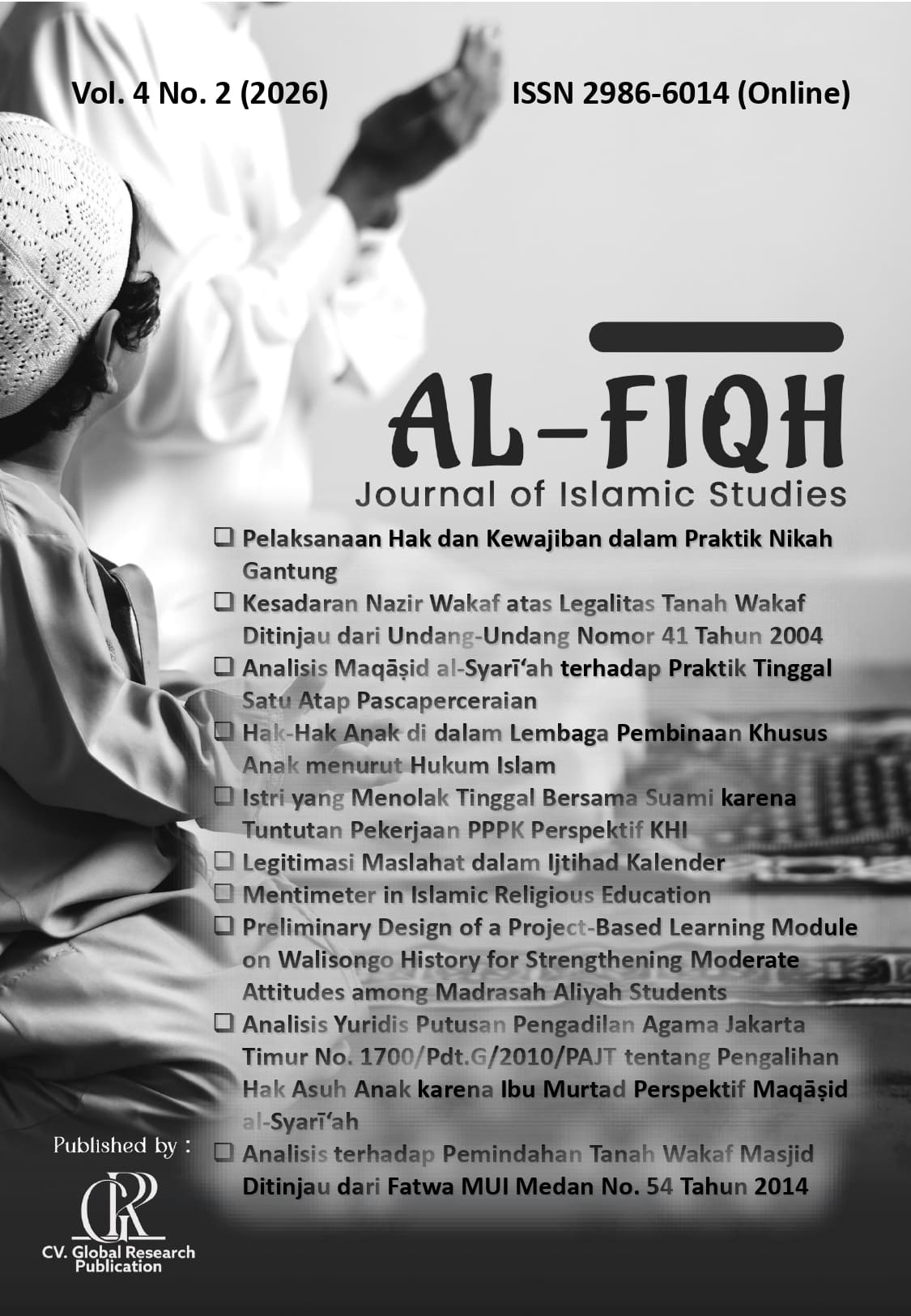
Analisis terhadap Pemindahan Tanah Wakaf Masjid
Studi Kasus Masjid Amal Silaturrahim Sukaramai II Ditinjau dari Fatwa MUI Nomor 54 Tahun 2014
DOI:
https://doi.org/10.59996/al-fiqh.v4i2.1212Keywords:
Waqf Istibdāl, MUI Fatwa No. 54/2014, Empirical Legal Study, Oral WaqfAbstract
Relocation of mosque waqf land (istibdāl) is permissible under urgent conditions (ḥājah/ḍarūrah) to ensure continuous benefits while fulfilling formal legalities. However, empirical reality reveals widespread waqf land relocations in urban areas that fail to comply with substantive and procedural criteria, thereby triggering conflicts over the perpetuity of religious assets. This study aims to analyze the legal validity of land status and the execution of the relocation of the Amal Silaturrahim Mosque Sukaramai II in Medan, viewed from the perspective of MUI Fatwa Number 54 of 2014, Agrarian Law regulations, and the principles of istibdāl under Islamic law. This research employs empirical legal research (socio-legal) with a qualitative approach. Primary data were gathered through in-depth interviews with the Mosque Welfare Board (BKM), community leaders, and key stakeholders, while secondary data comprised MUI Fatwa No. 54 of 2014, Law No. 41 of 2004 on Waqf, and Law No. 5 of 1960 (UUPA). Data were analyzed descriptively and qualitatively. The findings reveal that: 1) The land of the Amal Silaturrahim Mosque is validly categorized as musabbal waqf based on the doctrine of mu‘āṭāh and land recognition, despite originating from an oral pledge in 1955; 2) The execution of the relocation by PT Perumnas fails to meet both substantive and procedural criteria. Substantively, the relocation was driven by commercial interests without genuine necessity and failed to fulfill the dhamān (quality guarantee) doctrine, as evidenced by the replacement mosque deteriorating within less than ten years. Procedurally, administrative approvals bypassed local sociological considerations and official MUI recommendations. Consequently, the Land Agency (BPN) and Indonesian Waqf Board (BWI) are urged to prioritize issuing the formal Waqf Certificate and demand physical restoration of the replacement mosque for legal certainty.
References
Aisyah, A. (2025). The Urgency of Waqf Land Certification in Ensuring Legal Certainty of Land Rights. Ipso Jure, 2(6), 1–12. https://doi.org/10.62872/4z6b7p84
Anggriani, J., Noviarita, H., Said, H. A., & M. Nainin, D. (2025). Digitalization of Land Certification: Legal Perspectives from Islamic, Positive, and Administrative Law. Al-Istinbath: Jurnal Hukum Islam, 10(2), 606–630. https://doi.org/10.29240/jhi.v10i2.12921
Askouri, E. (2024). The Role of Waqf in Achieving the Purposes of Islamic Law. Iqtisad: Reconstruction of Justice and Welfare for Indonesia, 11(1), 101–120. https://doi.org/10.31942/iq.v11i1.10922
Batul, F. Z. (2025). The Basic Concept of Proceedings in Religious Courts: Sharia Perspectives and Positive Law. Al-Mawaddah: Jurnal Studi Islam Dan Hukum Keluarga (Ahwal Al-Syakhsiyyah), 2(2), 50–55. https://doi.org/10.61181/32xvzn53
Creswell, J. W., & Creswell, J. D. (2018). Research Design: Qualitative, Quantitative, and Mixed Methods Approaches. SAGE Publications.
Fathony, F. R., Ziaharah, L. I., & Damiri, A. (2026). Problematika Hukum Tanah Masjid Tanpa Sertifikat Dan Ikrar Wakaf: Studi Kasus Masjid Al Ukhuwwah Panyileukan. USRAH: Jurnal Hukum Keluarga Islam, 7(April), 793–804.
Harahap, M. (2025). Hasil Wawancara. Medan
Haris, A. H., Aqbar, K., & Bakry, K. (2024). Status Kepemilikan Tanah Wakaf (Studi Perbandingan UU No. 41 Tahun 2004, KHI dan Fikih Muamalah). AL-FIKRAH: Jurnal Kajian Islam, 1(1), 46–66. https://doi.org/10.36701/fikrah.v1i1.1653
Hasibuan, M. (2025). Hasil Wawancara. Medan
Hidayat, M. F., & Amri, S. (2026). Kesadaran Nazir Wakaf atas Legalitas Tanah Wakaf Ditinjau dari Undang-Undang Nomor 41 Tahun 2004. Al-Fiqh, 4(2), 93–103. https://doi.org/10.59996/al-fiqh.v4i2.1151
Hidayat, R. (2023). Kepemilikan Benda Wakaf dan Akibat Hukumnya: Kajian Pendapat Ulama Mazhab. Muqaranah, 7(2), 91–104. https://doi.org/10.19109/muqaranah.v7i2.20046
Huda, M. H., & Madarik, M. (2024). Praktik Istibdal Wakaf Dalam Perspektif Imam Syafi’I Dan Undang-Undang No. 41 Tahun 2004: Analisis Kemaslahatan dan Maqāṣid Al-Syarī‘Ah. Maqashid, 7(2), 67–79. https://doi.org/10.35897/maqashid.v8i1.2048
Ilyas, M. (2016). Istibdal Harta Benda Wakaf Perspektif Hukum Islam. Jurisprudentie, 3(2), 138–150.
Islamiyati, I. (2018). Penyelesaian Sengketa Tanah Wakaf Yang Tidak Tersertifikasi di Wilayah Pesisir Utara Jawa Tengah. Masalah-Masalah Hukum, 47(1), 71. https://doi.org/10.14710/mmh.47.1.2018.71-80
Masriani, Y. T. (2024). Legal Protection for Buyers of Inherited Land Who Have Not Been Certified In Islamic Law. Jurnal USM Law Review, 7(3), 1360–1373. https://doi.org/10.26623/julr.v7i3.9524
Maysarah, & Yana, T. (2025). Customary Law System and the Influence of Religion on the Indonesian Legal System. Jurnal Multidisiplin Madani, 5(10), 1152–1159. https://doi.org/10.55927/mudima.v5i10.660
Miles, M. B., Huberman, A. M., & Saldana, J. (2020). Qualitative Data Analysis : A Methods Sourcebook. California: Sage Publications India Pvt Ltd.
Muhaimin. (2026). Metode Penelitian Hukum. Mataram: Mataram University Press.
MUI. (2014). Fatwa Majelis Ulama Indonesia Nomor 54 Tahun 2014 Tentang Status Tanah yang di Atasnya ada Bangunan Masjid. Jakarta: Majelis Ulama Indonesia.
Muslihun. (2023). Manajemen Zakat & Wakaf di Indonesia: Ikhtiar Menemukan Konsep yang Efektif dan Ideal. NTB: CV Alfa Press. https://doi.org/10.32332/muamalah.v1i1.3552
Muzakki, A. R., & A’la, Z. A. (2025). Inalienable Land: Waqf-Based Land Tenure Security for Cooperative Urban Housing in Indonesia. Bulletin of Indonesian Islamic Studies, 4(2), 832–852. https://doi.org/10.51214/biis.v4i2.1689
Pradana, S., Holijah, & Syafran Afriansyah. (2025). Reconstruction of Holistic Benefits in Resolution of Wakf Land Disputes in Palembang. Nurani: Jurnal Kajian Syari’ah Dan Masyarakat, 25(2), 620–638. https://doi.org/10.19109/nurani.v25i2.27754
Qolbunnuzuli, D., Syibly, M. R., & Artikel, I. (2023). Ruislagtanah Wakaf Belum Bersertifikat Untuk Proyek Jalan Tol dalam Perspektif Hukum Islam. Al-Mawarid Jurnal Syariah Dan Hukum (JSYH), 5(2), 159–172.
Sinaga, G. (2024). Hasil Wawancara. Medan
Suhaimi, M. F. (2024). Keperluan Mengenalpasti Risiko Dalam Proses Istibdal Harta Wakaf. Journal of Contemporary Islamic Studies, 10(1), 1–10. https://doi.org/10.24191/jcis.v10i1.9
Taufik, F., & Aprillillah, Y. N. I. (2022). Application of Waqf In Modern Islamic Boarding School Darussalam Gontor Ponorogo Regency In The Perspective of Sharia Economic Law And Law Number 41 Of 2004 Concerning Waqf. Al-Muamalat: Jurnal Ekonomi Syariah, 9(1), 1–6. https://doi.org/10.15575/am.v9i1.14248
Waluya, A. (2018). Istibdal Wakaf Dalam Pandangan Fukaha Klasik Dan Kontemporer. Misykat Al-Anwar Jurnal Kajian Islam Dan Masyarakat, 1(2), 58–75. https://doi.org/10.24853/ma.1.2.58-75
Yeni, S. B., & Mardani. (2026). Tukar Menukar Harta Benda Wakaf untuk Kepentingan Umum. Al-Zayn: Jurnal Ilmu Sosial & Hukum, 4(4), 12187–12194. https://doi.org/10.61104/alz.v4i3.10133
Yumna, A., Marta, J., & Yanuarta RE, R. (2026). The impact of financial and social inclusion on well-being: evidence from a Waqf-based microfinance institution in Indonesia. International Journal of Ethics and Systems, 42(4), 1083–1098. https://doi.org/10.1108/IJOES-08-2024-0243
Downloads
Published
Issue
Section
License
Copyright (c) 2026 Mulya Hasbi, Syafruddin Syam

This work is licensed under a Creative Commons Attribution-ShareAlike 4.0 International License.