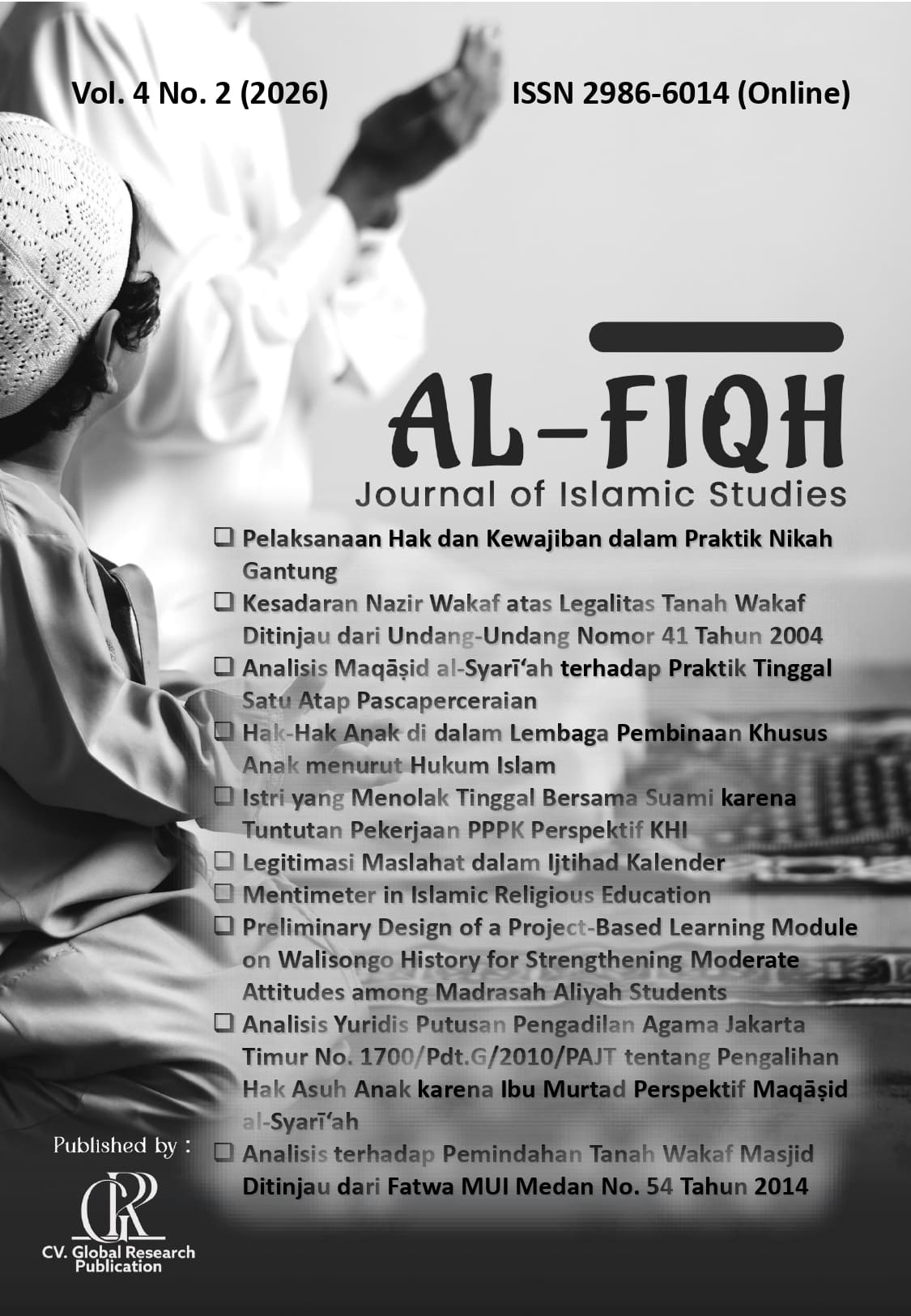
Legitimasi Maslahat dalam Ijtihad Kalender
Studi Istiḥsān terhadap Kalender Hijriah Global Tunggal (KHGT)
DOI:
https://doi.org/10.59996/al-fiqh.v4i2.1096Keywords:
Al-maṣlaḥah, Istiḥsān, Ijtihad, Global Unified Hijri CalendarAbstract
This article departs from the crucial problem of the absence of a unified Hijri calendar in the Muslim world, which has led to differences in the timing of worship, uncertainty in dating, and weak socio-religious integration among Muslims. This study aims to analyze Muhammadiyah’s Global Unified Hijri Calendar (Kalender Hijriah Global Tunggal/KHGT) from the perspective of al-maṣlaḥah and istiḥsān in usul al-fiqh, and to assess the extent to which KHGT can be justified as a valid form of ijtihad. This research employs a qualitative method with a library research approach. Data were obtained from classical usul al-fiqh works, academic books, scholarly journal articles, and official Muhammadiyah documents on KHGT. The data were processed using descriptive-analytical techniques and examined normatively by positioning al-maṣlaḥah and istiḥsān as evaluative instruments. The findings show that KHGT is not merely an astronomical formulation, but also a development of Muhammadiyah’s calendar ijtihad methodology from a local orientation toward a more planned, unified, and collectively beneficial global system. From the perspective of usul al-fiqh, KHGT may be understood as a valid form of istiḥsān, particularly through the approaches of istiḥsān bi al-al-maṣlaḥah and istiḥsān bi al-qiyās al-khafī, as long as it remains within the framework of naṣṣ, maqasid al-shari‘ah, and the discipline of usul al-fiqh. This article suggests that the development of a global Islamic calendar should continue to be accompanied by stronger usul al-fiqh argumentation and dialogue among religious authorities.
References
Abu Zahrah, M. (n.d.). Ushul al-Fiqh. Dar al-Fikr al-’Arabi.
Afida, H. N., Marhamah, S., & Budiwati, A. (2019). Global Islamic Calendar Digital Information Mapping. Al-Marshad: Jurnal Astronomi Islam Dan Ilmu-Ilmu Berkaitan, 5(1). https://doi.org/10.30596/jam.v5i1.3023
Al-Ghazali, M. (n.d.). Al-Mustashfa min ’Ilm al-Ushul. Dar al-Fikr.
Al-Sarakhsi. (1904). Al-Mabsuth: Juz X. Mathba‘ah al-Sa‘adat.
Al-Syafi’i, M. ibn I. (1969). Al-Risalah. Dar al-Fikr.
Al-Syatibi, I. (n.d.-a). Al-Muwafaqat fi Ushul al-Syari’ah: Juz I. Dar al-Hadits.
Al-Syatibi, I. (n.d.-b). Al-Muwafaqat fi Ushul al-Syari’ah: Juz II. Dar al-Ma‘rifah.
Al-Taftazani. (n.d.). Syarh al-Talwih ’ala al-Tawdih: Juz II. Dar al-Kutub al-’Ilmiyyah.
Al-Zuhaili, W. (2003). Ushul al-Fiqh al-Islami. Dar al-Fikr.
Angkat, A. (2017). Kalender Hijriah Global Dalam Perspektif Fikih. Al-Marshad: Jurnal Astronomi Islam Dan Ilmu-Ilmu Berkaitan, 3(2). https://doi.org/10.30596/jam.v3i2.1524
Anwar, S. (2016). Unified Islamic Calendar in the Perspective of Islamic Legal Philosophy. Al-Jami’ah, 54(1).
Anwar, S. (2017). Tindak Lanjut Kalender Hijriah Global Turki 2016: Tinjauan Usul Fikih. Tarjih, 13(2).
Anwar, S. (2019). Tinjauan Maqasid Syariah Terhadap Kalender Islam Global. Al-Marshad: Jurnal Astronomi Islam Dan Ilmu-Ilmu Berkaitan, 5(2). https://doi.org/10.30596/jam.v5i2.3801
Arafat, M., & Budiwati, A. (2025). Syamsul Anwar’s Vision: Establishing a Unified Global Islamic Calendar. AL - AFAQ : Jurnal Ilmu Falak Dan Astronomi, 7(1), 67–83. https://doi.org/10.20414/afaq.v7i1.11438
Azhari, S. (2012). Kalender Islam: Ke Arah Integrasi Muhammadiyah-NU. Museum Astronomi Islam.
Budiwati, A. (2017). Telaah Awal Kalender Hijriah Global Tunggal Jamaluddin ‘Abd al-razik: Sebuah Upaya menuju Unifikasi Kalender. Jurnal Bimas Islam, 10(3), 407–430. https://doi.org/10.37302/jbi.v10i3.29
Djamaluddin, T. (2011). Astronomi Memberi Solusi Penyatuan Ummat. LAPAN.
Fathurohman, O. (2023). Kalender Islam Global dan Wujudul Hilal: Teori dan Implementasi PY - 2023. Seminar Integrasi Keilmuan Dalam Hisab Dan Rukyat Universitas Muhammadiyah Yogyakarta.
Guessoum, N. (2011). Islam’s Quantum Question: Reconciling Muslim Tradition and Modern Science. I.B. Tauris.
Ibn Qudamah. (1978). Raudat al-Nazir wa Jannat al-Munazir. Universitas Muhammad bin Sa’ud.
Izzuddin, A. (2007). Fiqh Hisab Rukyat: Menyatukan NU & Muhammadiyah dalam Penentuan Awal Ramadhan, Idul Fitri, dan Idul Adha. Erlangga.
Kamali, M. H. (2003). Principles of Islamic Jurisprudence. Islamic Texts Society.
Khallaf, A. W. (2003). Ilmu Ushul Fiqh. Pustaka Amani.
Mahsun. (2015). Rekonstruksi Pemikiran Hukum Islam Melalui Integrasi Metode Klasik Dengan Metode Saintifik Modern. Al-Ahkam, 25(1).
Majelis Tarjih. (2025). Memahami Kalender Hijriah Global Tunggal Secara Ringkas. Tajdid PP Muhammadiyah.
Mufid, A. (2020). Unification of Global Hijrah Calendar In Indonesia: An Effort To Preserve The Maqasid Sunnah of The Prophet (SAW). Journal of Islamic Thought and Civilization, 10(2). https://doi.org/10.32350/jitc.102.02
Muhammad bin Ismail al-Bukhari. (2001). Sahih al-Bukhari: juz III. Dar Tawq an-Najah.
Muhammadiyah. (2025a). Kalender Hijriah Global Tunggal (KHGT).
Muhammadiyah. (2025b). Menjawab Kritik terhadap Kalender Hijriah Global Tunggal: Hilal di Bawah Ufuk.
Musonnif, A. (2024). Islamic Law and Science in NU-Muhammadiyah’s Lunar Calendar Determination. Al-Hilal, 6(2).
Syarif, M. R., & Sakirman. (2025). Reconstructing Ijtih?d in Unifications the Islamic Calendar: Jasser Auda’s Maq?shid al-Shar?`ah Approach. AL - AFAQ : Jurnal Ilmu Falak Dan Astronomi, 7(1), 84–103. https://doi.org/10.20414/afaq.v7i1.13229
Tajrid, A. (2021). Tracing the Genealogy of Maqasid al-Shari’ah Concept: A Historical Approach. Al-Ahkam, 31(1).
Yaqin, ‘Alamul. (2023). The Global Islamic Calendar as a Solution for Unified Religious Rituals: Its Relevance to Fiqh and Astronomy. KULMINASI: Journal of Falak and Sharia, 1(1), 34–55. https://doi.org/10.22373/kulminasi.v1i1.4086
Zaidan, A. K. (2002). Al-Wajiz fi Ushul al-Fiqh. Mu’assasah al-Risalah.
Zed, M. (2008). Metode Penelitian Kepustakaan. Yayasan Pustaka Obor Indonesia.
Downloads
Published
Issue
Section
License
Copyright (c) 2026 Jundil Ikrom, Amir Tajrid, Mahsun Mahsun

This work is licensed under a Creative Commons Attribution-ShareAlike 4.0 International License.